
Designing healthcare facilities, clinical laboratories, and research environments across the United Arab Emirates requires strict adherence to safety, hygiene, and durability standards. When sourcing materials, selecting the right solid surface for your next commercial project means balancing these clinical demands with overall design flexibility. In these high-stakes environments, choosing the wrong material can compromise infection control, lead to costly structural failures, and jeopardise compliance with local health regulations like the Dubai Health Authority and the UAE Ministry of Health and Prevention.
A critical element of these facilities is the operational surface. While traditional materials like plastic laminates, stainless steel, and natural stone have historical precedent, modern medical architecture demands advanced material science. A premium solid surface worktop engineered from a homogeneous blend of natural minerals and pure acrylic resins has emerged as the definitive benchmark for clinical environments. This technical analysis explores the rigorous performance requirements for surfaces in medical and laboratory settings and examines why advanced solid surfacing outclasses traditional specifications.
Solid Surface Worktop Technical Analysis: The Clinical Failures of Traditional Surfaces
To understand why a full acrylic solid surface worktop is the required standard, it is essential to contrast its properties against traditional alternatives that frequently fail under the pressures of a medical environment.
| Material Type | Joint/Seam Integrity | Chemical & Microbial Resistance |
| Plastic Laminates | Vulnerable glued seams; prone to water ingress and swelling. | Delaminates under moisture; harbours bacteria at joints. |
| Stainless Steel | Visible welded joints; prone to scratching and denting over time. | Resists chemicals well but shows scratches that shelter microbes. |
| Premium Acrylic Solid Surfacing | Completely seamless chemical bond; zero gaps for contamination. | Impervious to liquids; inherently antimicrobial and non-porous. |
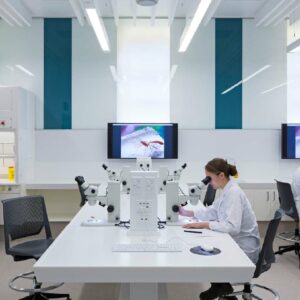
Traditional modular wood or laminate systems rely on edge banding and glued joints. In a medical laboratory, these seams represent an immediate point of failure. Moisture from frequent washdowns penetrates these gaps, causing the substrate to swell, warp, and delaminate. More critically, these microscopic crevices become breeding grounds for dangerous pathogens.
While stainless steel offers excellent heat resistance, it is highly susceptible to scratching and denting. Over time, these surface abrasions create microscopic valleys where bio-burden can accumulate, resisting standard sanitisation protocols. Furthermore, stainless steel can feel cold, industrial, and clinical in a way that negatively impacts patient psychology in public-facing healthcare spaces. Natural stone, such as granite or marble, features a chaotic internal structure full of natural fissures and pores. Even when sealed, it remains vulnerable to chemical etching and bacterial penetration, rendering it entirely unsuitable for cleanrooms. This aligns with broader shifts in healthcare design, where prioritising top commercial surface trends means moving toward entirely non-porous, seamless environments to guarantee infection control.
Conversely, specifying a premium solid surface worktop eliminates these vulnerabilities. Advanced acrylic solid surfacing is completely homogeneous and non-porous. Because the sheets are joined with a colour-matched acrylic adhesive that chemically bonds them, the final installation is entirely seamless. This seamless integration ensures there are no cracks, grout lines, or seams to trap dirt, moisture, or biohazardous waste.
The Architectural Value Proposition: Long-Term ROI and Safety
In UAE commercial and healthcare developments, procurement managers and developers must look beyond initial capital expenditure to evaluate the lifecycle cost and return on investment for solid surface materials. Specifying an inferior solid countertop or laminate system to save on upfront costs often backfires due to premature replacement cycles and intensive maintenance routines.
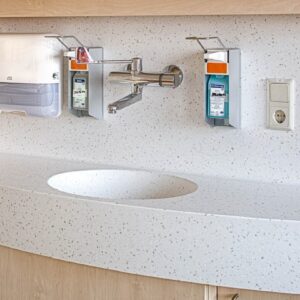
A high-performance solid surface countertop delivers exceptional long-term value through three core technical attributes:
- Inherent Infection Control: Because the material is non-porous throughout its entire thickness, it does not support the growth of mould, mildew, or bacteria. It easily withstands daily exposure to harsh medical disinfectants, chemical sterilisers, and sanitising agents without staining, bleaching, or degrading.
- Complete Repairability: In high-traffic clinical wards, surfaces are subjected to impact from mobile medical equipment, heavy diagnostic machinery, and surgical tools. Unlike laminates, which must be completely torn out if punctured, or stone, which can chip permanently, acrylic solid-state countertops are entirely renewable. Scratches can be buffed out, and deep gouges can be seamlessly patched on-site by a certified fabricator, restoring the surface to its original, sterile state without disrupting operations.
- Thermoformable Adaptability: Healthcare spaces require specialised design interventions, such as integrated splashbacks, coved tile transitions, and anti-drip marine edges to contain liquid spills. The thermal elasticity of acrylic solid surfaces allows fabricators to heat and mould the material into fluid, organic shapes. Sinks and basins can be integrated directly into the deck with perfectly radiused internal corners, removing any sharp transitions where contaminants could hide.
Engineering the Future of UAE Healthcare Infrastructure
As the UAE continues to invest heavily in world-class medical cities, research hubs, and diagnostic laboratories, the demand for uncompromising material specifications has never been higher. Selecting a high-performance solid surface worktop provides the precise balance of clinical compliance, aesthetic flexibility, and long-term durability required by modern medical briefs.
By eliminating the structural and hygienic risks associated with traditional multi-material fabrications, architects and contractors can deliver spaces that protect patient health, streamline facility maintenance, and offer an exceptional lifecycle return on investment.
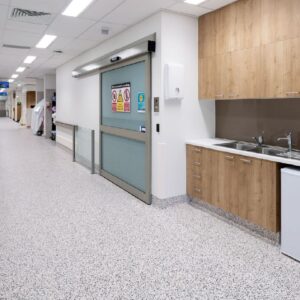
Specify with Confidence
Ready to elevate your next medical, laboratory, or high-traffic healthcare project? Partner with the region’s premier surface specialists.
Discover the full range of premium acrylic solutions and connect with an industry expert today by visiting Salvocorp UAE Solid Surfaces to view detailed material specifications and request physical samples for your design boardroom.